


Document
BSMT Logo Reconstruction from the Legacy Mark
Purpose
This is not an arbitrary redesign. It is a forensic reconstruction of the existing approved mark. The objective was to preserve its recognisable identity while recovering a coherent geometric logic suitable for reproducible digital and print production.
Source mark
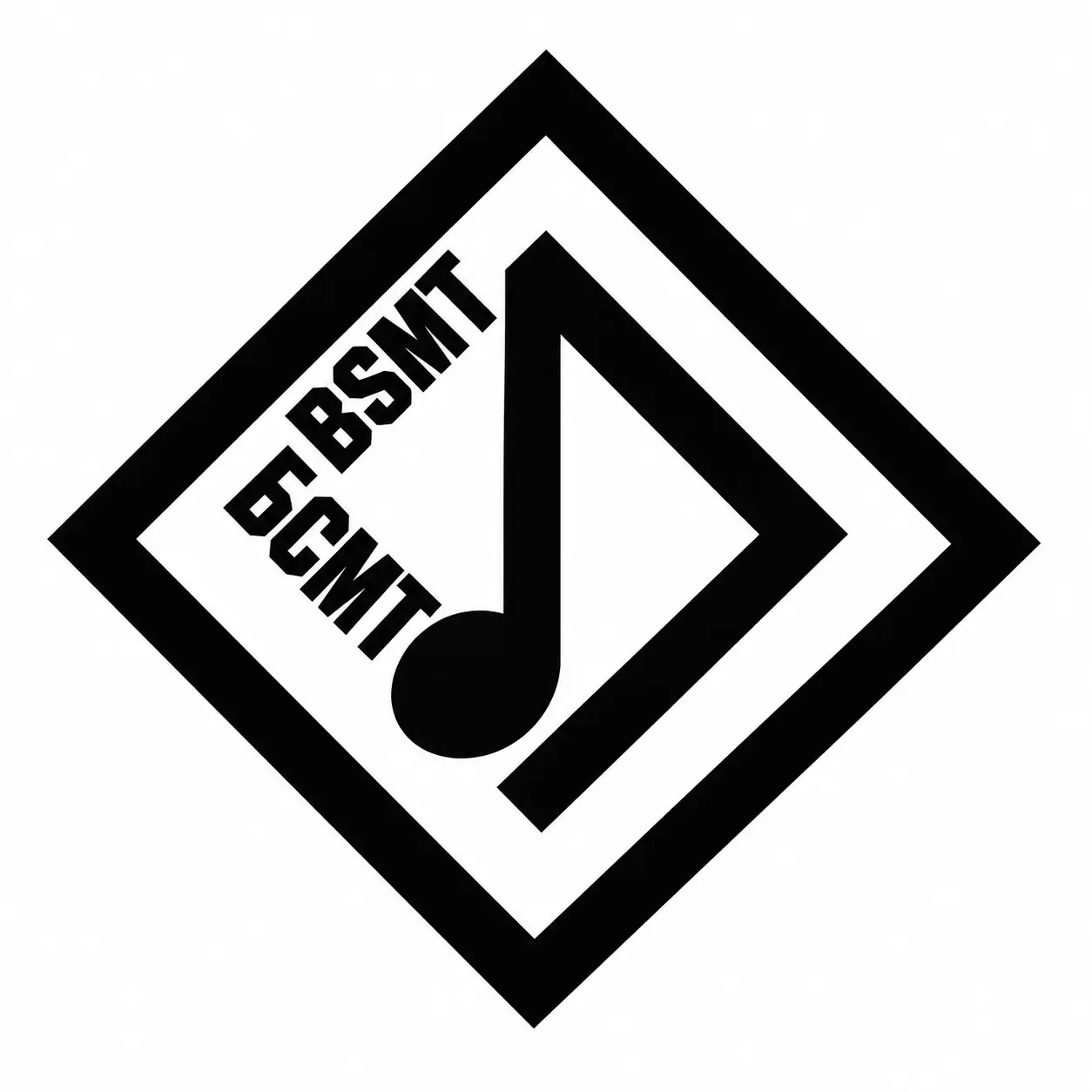
The approved legacy BSMT logo is treated as the authoritative source. Its silhouette, lettering relationship, note, side pins and rotated-square frame are preserved as identity-bearing features rather than replaced by a newly invented symbol.
Analytical method
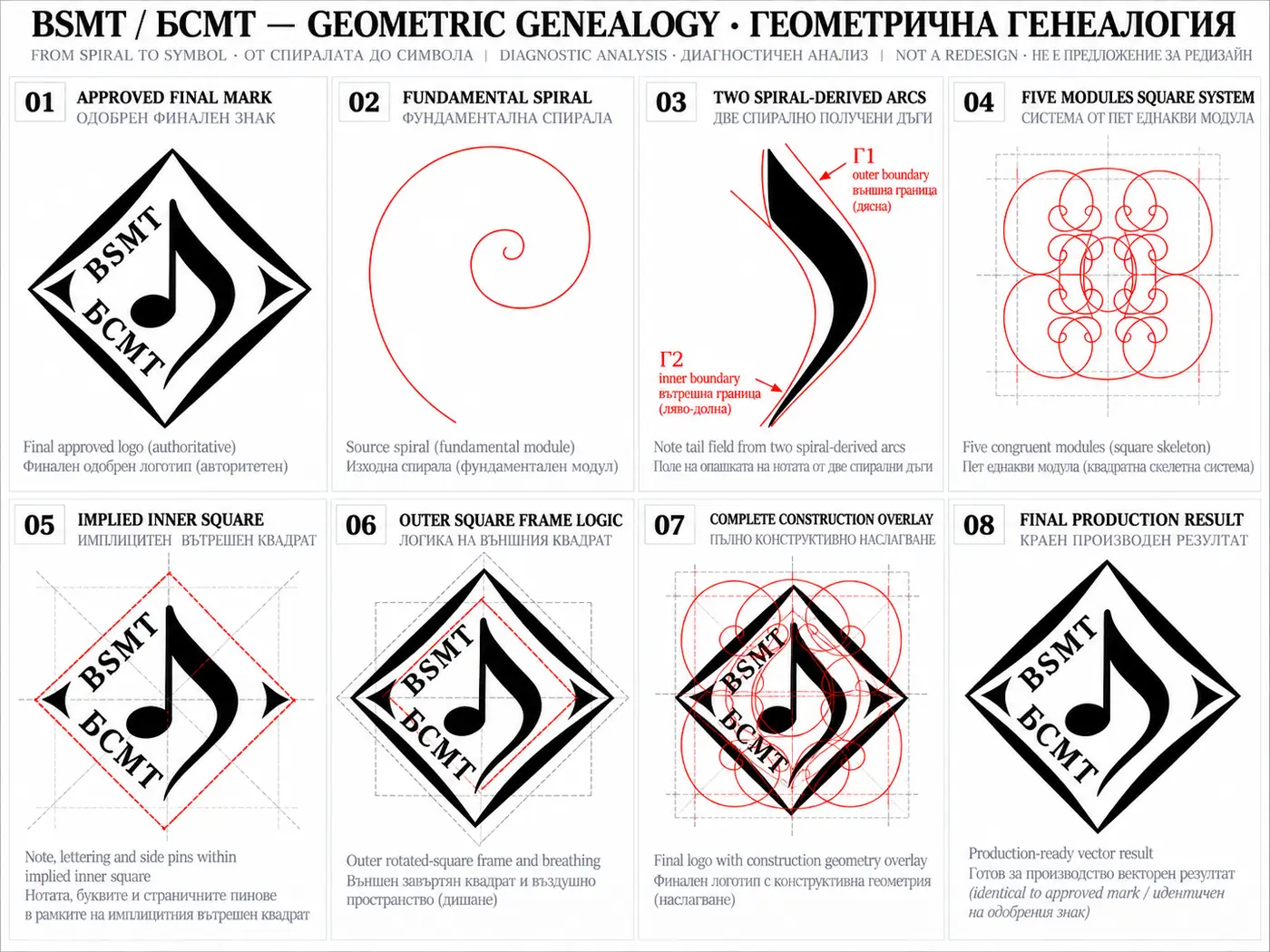
The reconstruction proceeded by visual-forensic decomposition: isolating the note-tail field, identifying two spiral-derived boundary arcs, recovering the implied inner square and the outer rotated-square frame, and testing those elements against a repeatable modular construction.
Reconstruction sequence
- Approved final mark: the legacy sign is fixed as the authoritative reference.
- Fundamental spiral: a source spiral provides the geometric family from which the tail boundaries are derived.
- Two spiral-derived arcs: the note-tail is analysed as a filled field bounded by an outer/right arc and an inner/left-lower arc.
- Five-module square system: congruent modules establish the underlying construction grid.
- Implied inner square: note, lettering and side pins are related to the internal square logic.
- Outer square frame: the diamond is treated as a true rotated square with balanced breathing space.
- Construction overlay: the recovered geometry is superimposed on the mark to verify proportion and alignment.
- Production result: the final vector form retains the approved identity while becoming reproducible and system-ready.
Conclusion
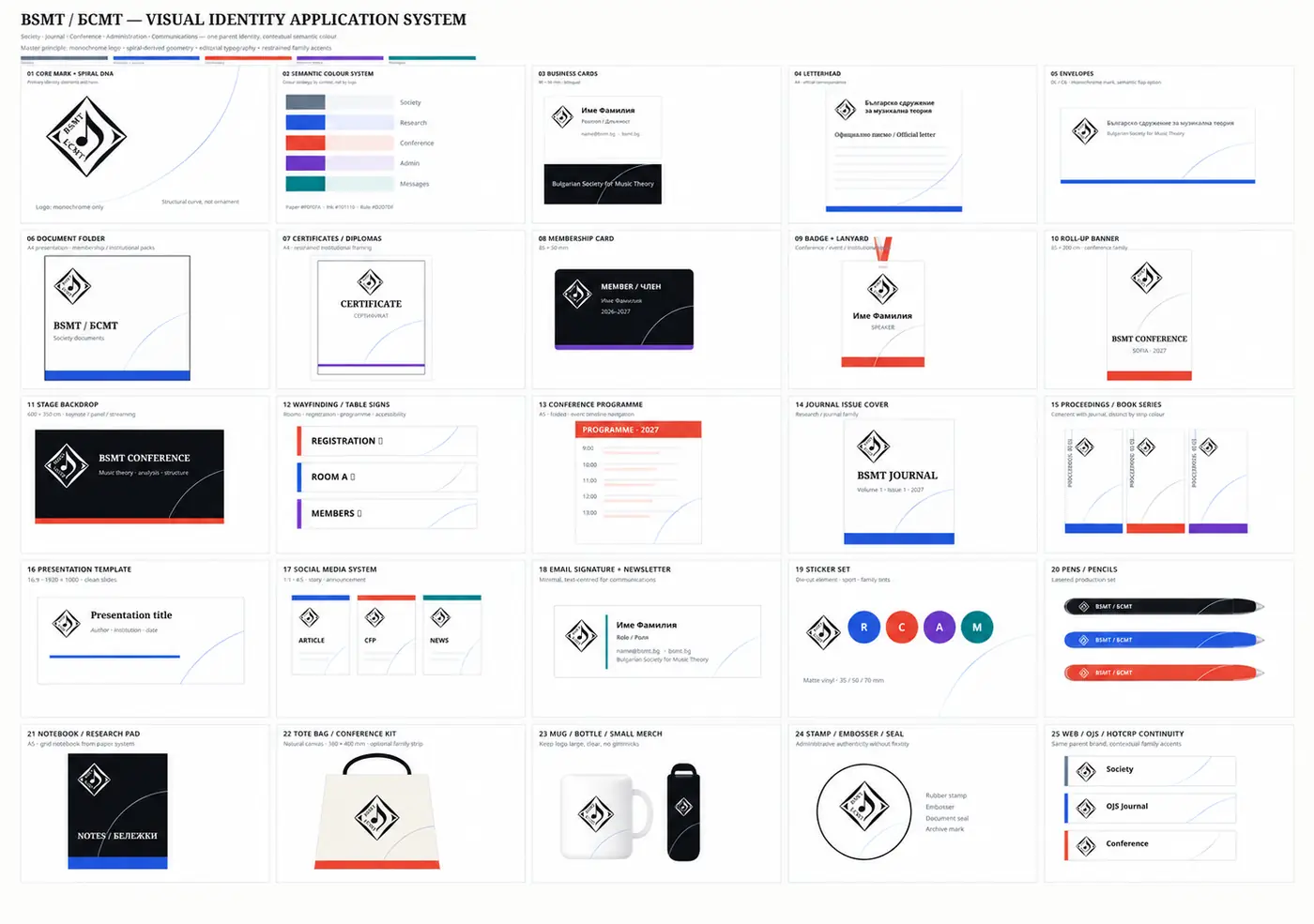
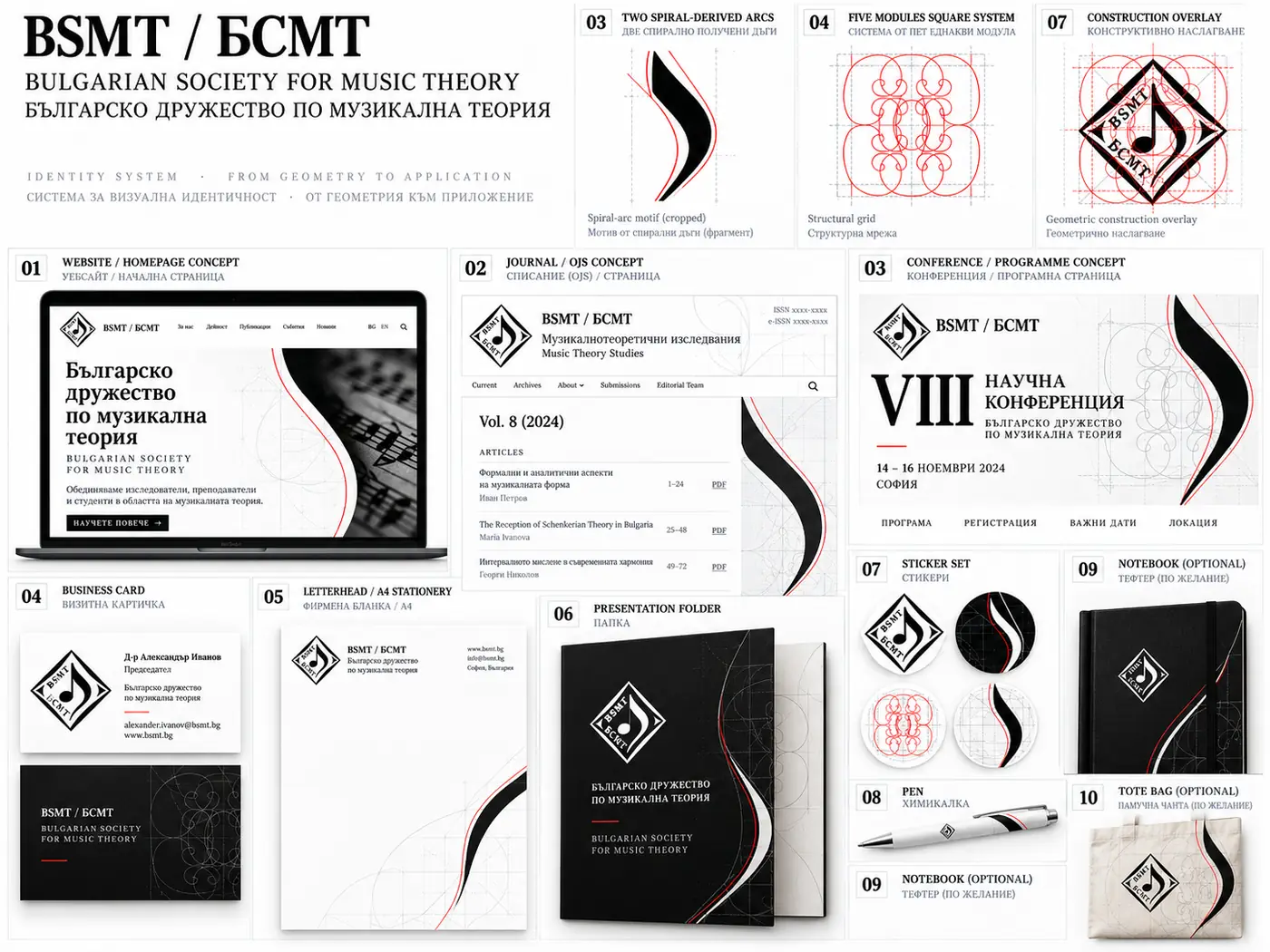
The production mark is therefore a geometrically normalised continuation of the legacy logo, not a replacement identity. The reconstruction supplies a documented basis for consistent use across the Society website, journal/OJS, conferences, stationery and other applications.